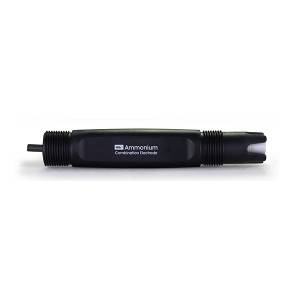
CS6710C Fluoride Ion Electrode Sensors Rs485 Modbus 4-20ma

Short Description:

The Fluoride Ion-Selective Electrode (ISE) is a highly specialized and reliable electrochemical sensor designed for the direct potentiometric measurement of fluoride ion (F⁻) activity in aqueous solutions. It is renowned for its exceptional selectivity and is a standard tool in analytical chemistry, environmental monitoring, industrial process control, and public health, most notably for optimizing fluoridation in drinking water.
The core of the electrode is a solid-state sensing membrane typically composed of a single crystal of lanthanum fluoride (LaF₃). When in contact with a solution, fluoride ions from the sample interact with the crystal lattice, generating a measurable electrical potential across the membrane. This potential, measured against an internal reference electrode, is logarithmically proportional to the fluoride ion activity according to the Nernst equation. A critical prerequisite for accurate measurement is the addition of a Total Ionic Strength Adjustment Buffer (TISAB). This solution serves three vital functions: it maintains a constant pH (usually around 5-6), fixes the ionic background to prevent matrix effects, and contains complexing agents to liberate fluoride ions bound by interfering cations like aluminum (Al³⁺) or iron (Fe³⁺).


Product Detail

Product Tags

CS6710C Fluoride Ion Electrode

Specifications:

Concentration range: 1M to 1x10⁻⁶M (saturation - 0.02ppm)

pH range: 5 to 7pH (1x10⁻⁶M) ;5 to 11pH (at saturation)

Temperature range: 0 - 80℃

Pressure resistance: 0 - 0.3MPa

Temperature sensor: NTC10K/NTC2.2K ;PT100/PT1000

Shell material: PP + GF

Membrane resistance: < 50MΩ

Connection thread: bottom NPT3/4, top G3/4

Cable length: 10m or as agreed

Cable connector: pins, BNC or as agreed

type fluoride ion electrode

Order Number

Name Content Number
temperature

sensor


None N0
NTC10K N1
NTC2.2K N2
PT100 P1
PT1000 P2
Cable length


5m m5
10m m10
15m m15
20m m20
 

Cable

connector


Tinning the wire ends A1
Y clip A2
Inserting a

single pin

A3
BNC A4

  • Previous:
  • Next:

  • Write your message here and send it to us