

Disinfectant water monitoring series
-
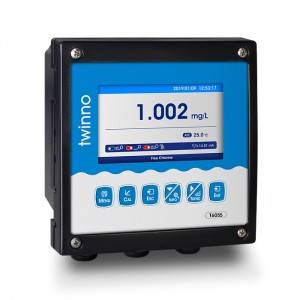
Online Membrane Residual Chlorine Meter T6055
Online residual chlorine meter is a microprocessor-based water quality online monitoring control instrument. -

Online Residual Chlorine Meter T6550
Online residual chlorine meter is a microprocessor-based water quality online monitoring control instrument.ndustrial online ozone monitor is a water quality online monitoring and control instrument with microprocessor. The instrument is widely used in drinking water treatment plants, drinking water distribution networks, swimming pools, water quality treatment projects, sewage treatment, water quality disinfection (ozone generator matching) and other industrial processes to continuously monitor and control the ozone value in the aqueous solution.
Constant voltage principle
English menu, easy operation
Data storage function
IP68 protection, waterproof
Quick response, high precision
7*24 hours continuous monitoring
4-20mA output signal
Support RS-485, Modbus/RTU protocol
Relay output signal,can set high and low alarm point
LCD display, muti-parameter display current time, output current, measure value
No need electrolyte, no need replace the membrane head, easy maintenance -
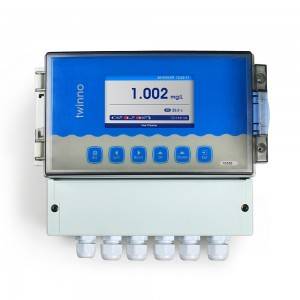
Online Membrane Residual Chlorine Meter T6555
Online residual chlorine meter is a microprocessor-based water quality online monitoring control instrument. -
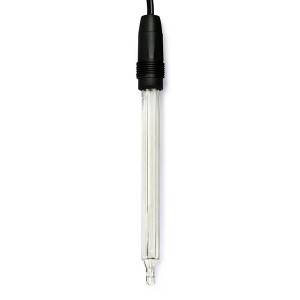
CS5560 Chlorine Dioxide Sensor
Specifications
Measuring Range:0 - 5.000 mg/L, 0 - 20.00 mg/L
Temperature Range:0 - 50°C
Double liquid junction,annular liquid junction
Temperature sensor: standard no, optional
Housing/dimensions: glass,120mm*Φ12.7mm
Wire: wire length 5m or agreed, terminal
Measurement method: tri-electrode method
Connection thread:PG13.5
This electrode is used with a flow channel. -

Online Chlorine Dioxide Meter T4053
Online chlorine dioxide meter is a microprocessor-based water quality online monitoring control instrument. -
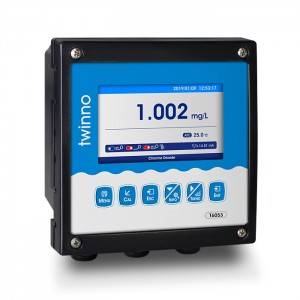
Online Chlorine Dioxide Meter T6053
Online chlorine dioxide meter is a microprocessor-based water quality online monitoring control instrument. -

T9259C Residual Chlorine Analyzer
Product Features:
Wide power input range, 7-inch touchscreen design
DPD colorimetric method for more precise and stable measurement
Selectable measurement cycle
Automatic measurement and automatic cleaning
External signal input can control measurement start or stop
Selectable automatic or manual mode
4-20mA and RS485 output, relay control
Data storage function, supports USB export -

T9262C Total Chlorine Analyzer
Product Features:
Wide power input range, 7-inch touch screen design
DPD colorimetric method, providing more accurate and stable measurement
Measurement cycle can be selected
Automatic measurement and automatic cleaning
-

T9260C Total Chlorine Analyzer
Product Features:
Wide power input range, 7-inch touch screen design
DPD colorimetric method, providing more accurate and stable measurement
Measurement cycle can be selected
Automatic measurement and automatic cleaning
-

T9258C Free Chlorine Analyzer
T9258C Free Chlorine Analyzer uses DPD colorimetric method to detect the concentration of residual chlorine. It is an instrument with accurate measurement, high cost performance and low maintenance. -

Residual Chlorine Meter Sensor Chlorine Analyzer T6550
Residual Chlorine Meter is a precision instrument designed for measuring the concentration of residual chlorine in water. Residual chlorine, which includes free chlorine (HOCI/OCl⁻) and combined chlorine (chloramines), is a vital indicator of water disinfection efficacy. It plays a critical role in ensuring public health safety across drinking water distribution systems, swimming pools, industrial cooling water, and wastewater disinfection processes. Maintaining appropriate residual chlorine levels helps prevent pathogen regrowth while avoiding excessive chlorine that may lead to harmful disinfection by-products (DBPs) or corrosion.
The meter primarily employs electrochemical or colorimetric methods for detection. Amperometric sensors, widely used in online and portable designs, apply a constant voltage to electrodes, generating a current proportional to chlorine concentration through reduction reactions. Colorimetric methods, such as the DPD (N,N-diethyl-p-phenylenediamine) reagent-based approach, produce a pink color when reacting with chlorine; the intensity is measured photometrically to determine concentration. Portable models often feature user-friendly interfaces, automatic temperature compensation, and calibration reminders to ensure accuracy in field applications.