

Products
-
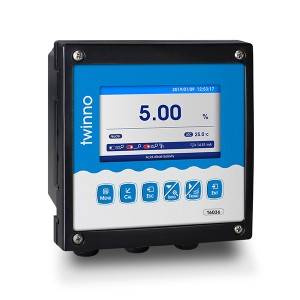
On-line Acid and Alkali Salt Concentration Meter T6036
Industrial online conductivity meter is a microprocessor-based water quality online monitoring control instrument, the salinometer measures and supervises the salinity (salt content) by conductivity measurement in fresh water. The measured value is displayed as percent and by comparing the measured value to a user defined alarm set point value, relay outputs are available to indicate if salinity is above or below the alarm set point value. -

CS4800 Dissolved Oxygen Electrode
DO electrodes are indispensable across numerous fields. In environmental monitoring, they assess the health of rivers, lakes, and oceans, as oxygen levels are a key indicator of water quality and ecosystem viability. In wastewater treatment plants, they are crucial for optimizing the biological treatment process by ensuring sufficient oxygen for microbial activity. Furthermore, they play essential roles in aquaculture to maintain healthy conditions for fish, in the food and beverage industry for process and quality control, and in pharmaceutical and biochemical research for monitoring cell cultures and fermentation processes.
Modern DO electrodes are often coupled with advanced meters for temperature and salinity compensation, ensuring high accuracy and reliability. Despite the emergence of optical fluorescence-based sensors, the electrochemical DO electrode remains widely valued for its robustness, proven performance, and cost-effectiveness in diverse laboratory and industrial settings. -

CS4802 Dissolved Oxygen Electrode
Unlike traditional electrochemical probes, the modern fluorescence-based dissolved oxygen (DO) sensor represents a revolutionary, membrane-free approach to oxygen measurement. Its operation relies on the principle of luminescence quenching rather than electrochemical reduction.
The core of the sensor is a specially designed optode or sensing spot, coated with a luminescent dye (often a ruthenium complex) embedded in a oxygen-permeable polymer matrix. A blue or UV light source from the instrument excites this dye, causing it to emit red light. When oxygen molecules are present, they interact with the excited dye molecules, quenching (reducing) the intensity and duration (lifetime) of this emitted luminescence. The degree of quenching is precisely and proportionally related to the partial pressure of dissolved oxygen. The instrument measures either the intensity or, more commonly and reliably, the phase shift or lifetime of the fluorescence, which is inherently more stable and less prone to drift. -

CS4762CD Dissolved Oxygen Sensor
Unlike traditional electrochemical probes, the modern fluorescence-based dissolved oxygen (DO) sensor represents a revolutionary, membrane-free approach to oxygen measurement. Its operation relies on the principle of luminescence quenching rather than electrochemical reduction.
The core of the sensor is a specially designed optode or sensing spot, coated with a luminescent dye (often a ruthenium complex) embedded in a oxygen-permeable polymer matrix. A blue or UV light source from the instrument excites this dye, causing it to emit red light. When oxygen molecules are present, they interact with the excited dye molecules, quenching (reducing) the intensity and duration (lifetime) of this emitted luminescence. The degree of quenching is precisely and proportionally related to the partial pressure of dissolved oxygen. The instrument measures either the intensity or, more commonly and reliably, the phase shift or lifetime of the fluorescence, which is inherently more stable and less prone to drift. -

CS4760PD Dissolved Oxygen Sensor
Unlike traditional electrochemical probes, the modern fluorescence-based dissolved oxygen (DO) sensor represents a revolutionary, membrane-free approach to oxygen measurement. Its operation relies on the principle of luminescence quenching rather than electrochemical reduction.
The core of the sensor is a specially designed optode or sensing spot, coated with a luminescent dye (often a ruthenium complex) embedded in a oxygen-permeable polymer matrix. A blue or UV light source from the instrument excites this dye, causing it to emit red light. When oxygen molecules are present, they interact with the excited dye molecules, quenching (reducing) the intensity and duration (lifetime) of this emitted luminescence. The degree of quenching is precisely and proportionally related to the partial pressure of dissolved oxygen. The instrument measures either the intensity or, more commonly and reliably, the phase shift or lifetime of the fluorescence, which is inherently more stable and less prone to drift. -

CS4760CD Dissolved Oxygen Sensor
technology offers significant advantages over conventional Clark-type electrodes. It requires no electrolytes, membranes, or periodic polarization, eliminating routine maintenance like membrane replacement and electrolyte refilling. It is unaffected by flow rate or stirring speed, provides a much faster response time, and does not consume oxygen during measurement, making it ideal for small sample volumes or biological cultures.
Consequently, fluorescence-based DO sensors have become the gold standard in applications demanding high precision, low maintenance, and minimal sample disturbance. They are extensively used in environmental monitoring (long-term deployments in buoys or profilers), wastewater treatment process control, aquaculture, pharmaceutical/bioreactor fermentation, and advanced laboratory research. By offering superior reliability and operational simplicity, they have redefined the landscape of dissolved oxygen analysis. -

CS4763 Dissolved Oxygen Electrode
dissolved oxygen (DO) electrode, also known as a Clark-type electrode, is a vital analytical tool for measuring the concentration of oxygen molecules in aqueous solutions. Its operation relies on electrochemical principles. The core component is a gas-permeable membrane, typically made of Teflon or polyethylene, which selectively allows oxygen to diffuse through. Behind this membrane lies an electrochemical cell consisting of a cathode (usually gold or platinum) and an anode (often silver), immersed in an electrolyte solution.
When a polarizing voltage is applied between the electrodes, oxygen molecules that diffuse through the membrane are reduced at the cathode. This reduction reaction generates an electric current that is proportional to the partial pressure of oxygen outside the membrane, following Faraday's law. The current signal is then converted into a DO concentration reading, commonly expressed in milligrams per liter (mg/L) or percent saturation. -

CS4773 Dissolved Oxygen Electrode
DO electrodes are indispensable across numerous fields. In environmental monitoring, they assess the health of rivers, lakes, and oceans, as oxygen levels are a key indicator of water quality and ecosystem viability. In wastewater treatment plants, they are crucial for optimizing the biological treatment process by ensuring sufficient oxygen for microbial activity. Furthermore, they play essential roles in aquaculture to maintain healthy conditions for fish, in the food and beverage industry for process and quality control, and in pharmaceutical and biochemical research for monitoring cell cultures and fermentation processes.
Modern DO electrodes are often coupled with advanced meters for temperature and salinity compensation, ensuring high accuracy and reliability. Despite the emergence of optical fluorescence-based sensors, the electrochemical DO electrode remains widely valued for its robustness, proven performance, and cost-effectiveness in diverse laboratory and industrial settings.
-

T9259C Residual Chlorine Analyzer
Product Features:
Wide power input range, 7-inch touchscreen design
DPD colorimetric method for more precise and stable measurement
Selectable measurement cycle
Automatic measurement and automatic cleaning
External signal input can control measurement start or stop
Selectable automatic or manual mode
4-20mA and RS485 output, relay control
Data storage function, supports USB export -

T9039K Automatic Water Quality Sampler
Controlled by a microcomputer and equipped with a high-precision peristaltic pump, it supports various sampling, analytical supply, and sample preservation modes, including timed, fixed-flow, and proportional sampling. It also enables remote control and data communication. -

T9262C Total Chlorine Analyzer
Product Features:
Wide power input range, 7-inch touch screen design
DPD colorimetric method, providing more accurate and stable measurement
Measurement cycle can be selected
Automatic measurement and automatic cleaning
-

T9260C Total Chlorine Analyzer
Product Features:
Wide power input range, 7-inch touch screen design
DPD colorimetric method, providing more accurate and stable measurement
Measurement cycle can be selected
Automatic measurement and automatic cleaning
-

T9258C Free Chlorine Analyzer
T9258C Free Chlorine Analyzer uses DPD colorimetric method to detect the concentration of residual chlorine. It is an instrument with accurate measurement, high cost performance and low maintenance. -

CS3501C Conductivity Sensor Analyser
The electrode typically features two graphite elements (cells) with a defined surface area and spacing, housed within a durable, chemically resistant body. When immersed, an alternating current is applied to prevent polarization. The ions in the solution facilitate current flow between the electrodes, generating a signal proportional to the solution's conductivity. A built-in temperature sensor (e.g., Pt1000) is essential for automatic compensation, as conductivity is highly temperature-dependent. Modern versions often incorporate multiple cells (like four-electrode designs) to extend range and minimize fouling errors.
The primary advantage of graphite over platinum is its superior cost-effectiveness and robustness in harsh or fouling-prone environments, such as wastewater, cooling towers, or chemical processes where abrasion or coating is a concern. However, graphite may have limitations in very high-precision or ultra-pure water applications compared to advanced platinum cells. -

CS3701C EC & TDS Conductivity Sensor Probe with RS485 Output
graphite conductivity electrode is a core component in sensors designed for measuring the electrical conductivity of various liquids, particularly water-based solutions. As an alternative to traditional platinum electrodes, graphite models offer distinct advantages in specific applications due to their material properties. Conductivity, a key indicator of total dissolved ionic solids (TDS) and water purity, is critical for process control in industries ranging from pharmaceuticals and power generation to wastewater treatment and agriculture.
Conductivity sensor technology is an important field of engineering and technology research, used for the liquid conductivity measurement, is widely used in human production and life, as electric power, chemical industry, environmental protection, food, the semiconductor industry research and development, Marine industrial production and essential in the development of technology, a kind of testing and monitoring devices.The conductivity sensor is mainly used to measure and detect industrial production water, human living water, seawater characteristics and battery electrolyte properties.